When your air conditioning quits in the middle of a Pennsylvania July, you need someone who picks up the phone and shows up. Most repairs done in a single visit.
Air conditioners in Delaware County rarely quit on a mild afternoon. They quit during the first stretch of 90-degree, high-humidity days, when the system runs for hours and every marginal capacitor, low refrigerant charge, and tired blower motor finally gives out at once. That is exactly when a homeowner needs a call answered and a truck on the way — not a voicemail box.
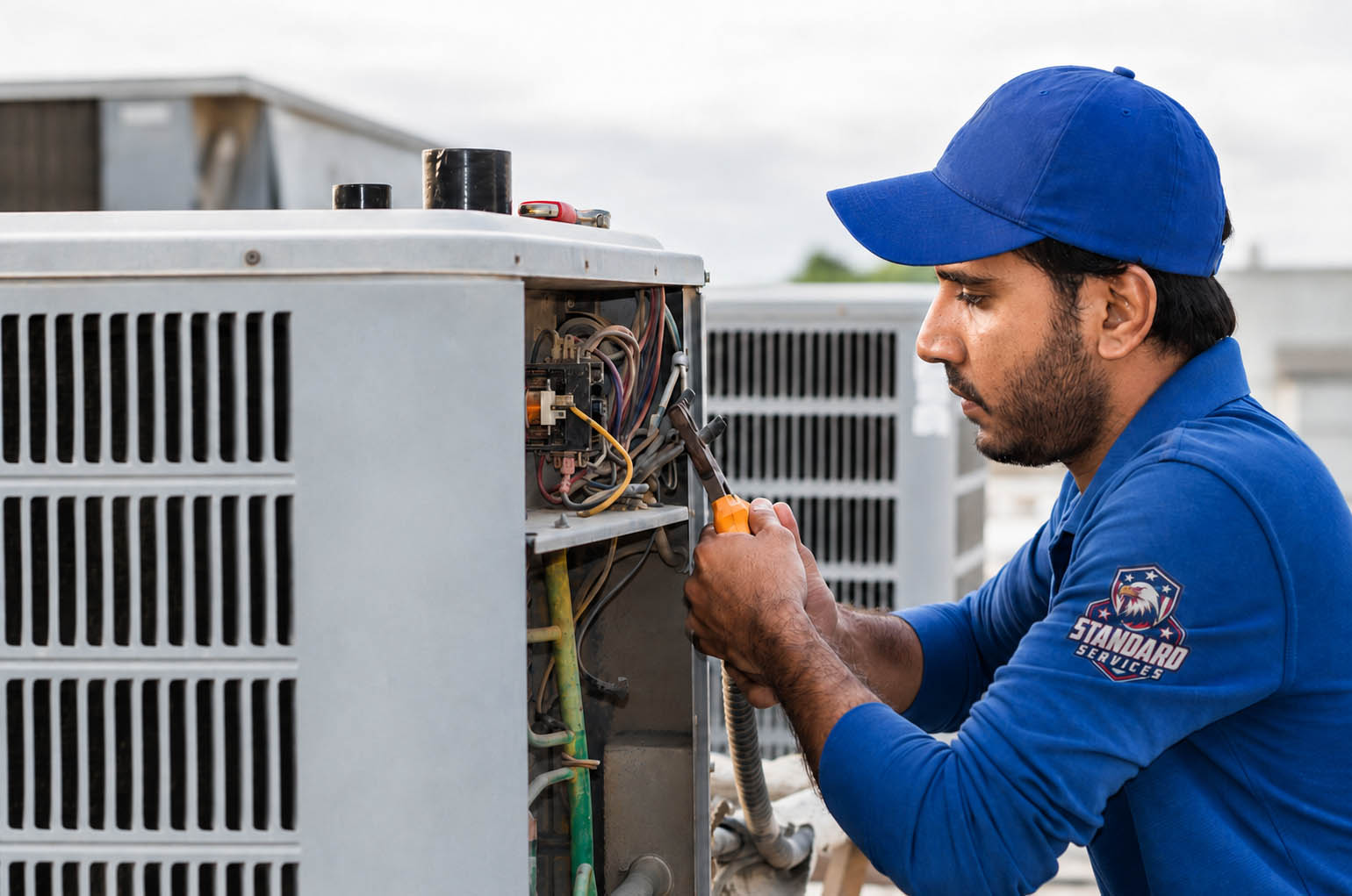
Standard Services handles the full arc of an AC repair in one visit whenever the part is on the truck: we diagnose the actual failure across the indoor and outdoor unit, quote it before we touch anything, and complete the repair on site. No guessing, no swapping parts and hoping, and no surprise on the invoice.
We are a licensed and insured, family-owned and women-owned company based in Glen Mills, and we have spent years working on the specific mix of equipment and older housing stock across Delco, Chester, and Montgomery Counties. That local familiarity is why we can usually tell you what is wrong before the panel is even off.
The system hums along but the air from the vents feels lukewarm. This usually points to a low refrigerant charge from a leak, a failing compressor, or a frozen coil restricting airflow — none of which fix themselves.
Barely a whisper coming out of the registers points to a failing blower motor, a clogged filter, or a duct problem. Weak airflow also freezes coils, so it tends to snowball if it's left alone.
It turns on, runs a couple of minutes, shuts off, and repeats. Likely causes are an oversized unit, a refrigerant charge problem, a failing capacitor, or a dirty coil. Guessing wrong here is what turns a small fix into a compressor replacement.
Pooling water or a damp air handler usually means a clogged condensate drain line or a frozen coil that's now thawing. Left alone it invites mold and can damage the flooring and drywall around the unit.
Grinding, buzzing, or clicking points to electrical or motor trouble. A burning smell means shut the system off — that can be an overheating motor or wiring, and it needs a technician before it becomes a hazard.
A sudden spike with no change in habits means the system is working harder to do less — from a dirty coil, low refrigerant, or a struggling compressor. Catching it early keeps a small repair from becoming an efficiency drain all season.
We find the leak, repair it, and recharge to the manufacturer's specified weight — we don't just top off R-410A, R-32, or legacy R-22 and send you on your way.
The most common no-cool call. A failed run capacitor or pitted contactor stops the compressor or fan from starting — a fast, stocked-on-the-truck repair.
Before we ever recommend a compressor, we confirm it with electrical and pressure testing — because it's the single most expensive component to get wrong.
Failed condenser fan motors, seized bearings, and dying blower motors kill airflow and cooling. We test amp draw and replace with the correct-spec motor.
Sometimes the system is fine and the brain isn't. We diagnose thermostats, control boards, and low-voltage wiring so you're not replacing hardware you don't need.
We clear the ice, find the root cause — airflow or refrigerant — and flush the condensate drain so the coil doesn't freeze and flood again next week.
Most AC repairs are completed in a single visit. Serving Delaware, Chester, and Montgomery Counties.
We ask about the symptoms up front — what it's doing, what you've heard, when it started — so the truck arrives carrying the parts most likely to fix it.
We check the indoor and outdoor unit together: electrical components, refrigerant charge, airflow, and controls. The real fault gets found, not just the first symptom.
You get a clear, written price and approve it before we touch a single component. No work happens until you say go.
Common parts — capacitors, contactors, motors, refrigerant — are stocked on the truck, so most repairs are finished the same visit.
We measure the supply-and-return temperature split and confirm the system is actually cooling to spec before we pack up and leave.
We don't post flat prices because no two repairs are the same, but we can be honest about the variables that move the number. The biggest one is which component failed: a run capacitor is a quick, inexpensive part, while a compressor is at the opposite end of the scale. Whether refrigerant is needed matters too, and so does the type — an R-410A or newer R-32 system is straightforward to service, but an older R-22 system is expensive to charge and increasingly impractical to keep running.
System age, how accessible the equipment is, and whether the failure damaged anything downstream all factor in as well. A frozen coil caught early is a simple fix; the same problem ignored for weeks can take out the compressor. Our diagnostic fee covers a full, no-guessing inspection, and when you move forward with the repair, that fee is credited toward the work. Either way, the price is agreed before we begin — you'll never see a number on the invoice you didn't approve at the door.
A good repair is often the smart move — but not always. We weigh a few things honestly: the system's age against its expected 12-to-15-year lifespan, whether the compressor is the part that failed, the refrigerant type, the cost of the repair as a fraction of a new system, and the efficiency you'd gain by upgrading. If the unit is eight years old and needs a capacitor, you repair it. If it's fourteen, on R-22, and facing a compressor, replacement usually wins.
Most catastrophic AC failures don't come out of nowhere. They start as a small, cheap problem — a slightly low charge, a coil that never gets cleaned, a capacitor reading a little weak — that gets deferred through one more summer. Under the sustained heat load of a Delaware County July, those marginal parts stop being marginal. A compressor that was starting hard for two seasons finally seizes, and a minor repair becomes a major one overnight. The single best way to avoid that is to catch the small stuff before the system is under maximum stress.
There's also a humidity dimension people underestimate. Southeastern Pennsylvania summers aren't just hot; they're sticky. A properly functioning air conditioner dehumidifies as much as it cools — it pulls moisture out of the air as it runs. When a system is undercharged, oversized, or short-cycling, it never runs long enough to wring that moisture out, so the house feels clammy and cold at the same time and you crank the thermostat lower chasing comfort you can't reach. That's a comfort problem and an energy problem wrapped together, and it's often traceable to a repair that was never made.
Older housing stock across Delco boroughs adds another wrinkle. Many homes in Media, Springfield, Swarthmore, and the surrounding towns were built long before central air was standard, and the ductwork and electrical service were retrofitted or sized for a different era. Undersized returns, leaky duct runs in a hot attic, and electrical panels near their limit all put extra strain on the cooling equipment. A repair on that kind of system is as much about understanding the house as the unit — and it's why local experience matters more than a parts swap.
Systems tend to fail in July specifically for a simple reason: it's the first sustained heavy load of the season. Components that limped through the mild days of June get their real test when the equipment runs for hours at a stretch, and that's when the weak links show themselves. If your air conditioner struggled at the end of last summer, don't wait for the heat to expose it again — a spring check-up or an early repair almost always costs less than an emergency one. For homeowners who want cooling and heating from a single system, we can also walk you through heat pump options that handle both.
Whatever the situation, our promise is the same: we diagnose the real problem, we tell you the truth about repair versus replacement, and we quote it before we start. That's the difference between a repair that lasts and a repair that just resets the clock until the next breakdown.
Standard Services provides AC repair throughout Delaware, Chester, and Montgomery Counties. Whether you're in a twin in Media, a ranch in Broomall, or a new build in Glen Mills, we're your local air conditioning repair team.
Same-day appointments available across Delaware, Chester, and Montgomery Counties.
Tell us a little about your home and we'll set up a free in-home estimate — real load sizing, honest equipment options, and a written proposal you can compare. Prefer to talk it through? Call 610-545-1000.
Serving Glen Mills, Newtown Square, Bryn Mawr & all of Delaware, Chester, and Montgomery Counties.

Glen Mills’ Trusted HVAC & Plumbing Experts