A new system is only as good as the install. We size it properly, install it cleanly, and prove it's performing before we leave.
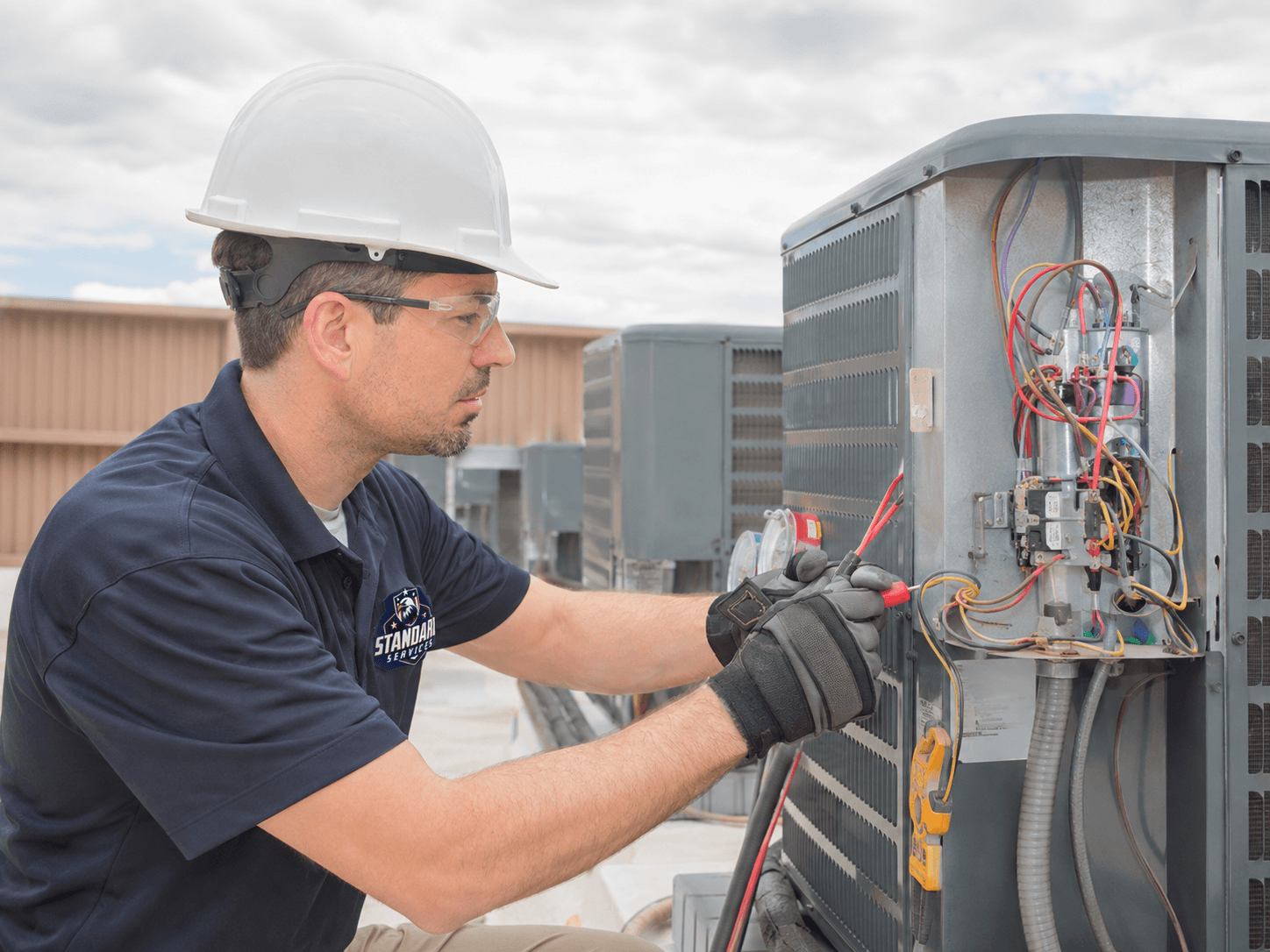
Replacing an air conditioner is one of the larger decisions a homeowner makes, and the equipment you buy matters far less than the crew that installs it. A premium condenser that's oversized, undercharged, or paired with leaky ductwork will underperform a mid-tier system that was sized to the load and commissioned properly. That gap — between the box on the truck and the system running in your home — is exactly where Standard Services earns its keep.
We install central air, ductless mini splits, and heat pumps for homes throughout Delaware, Chester, and Montgomery Counties. Every project starts with a real load calculation, moves to a written proposal you can actually compare, and ends with a startup process where we verify refrigerant charge by weight, measure airflow, and confirm the temperature split before we hand the thermostat back to you.
We're family-owned and women-owned, fully licensed and insured in Pennsylvania, and we've spent years working on the older colonials, twins, and new builds that make up Delco and the Main Line. That local familiarity — knowing what a 1950s Havertown duct system looks like versus a new Glen Mills build — is what keeps our installs quiet, efficient, and comfortable for the long haul.
A few clear signals mean a new system will cost you less to run — and far less stress — than nursing the old one through another summer.
Most central systems lose efficiency and reliability past the 12-to-15-year mark. Once yours is there, replacement usually beats another round of parts.
When a major repair on an aging unit approaches the cost of a new system, that money is better invested in equipment that comes with a fresh warranty.
Older units run on R-22, which is no longer produced. A leak on one of these systems is expensive to recharge and a clear signal it's time to move on.
Bedrooms over the garage or a finished third floor that never cool down often point to an undersized or poorly matched system — the right replacement fixes it.
A cooling bill that keeps climbing while the house feels the same means the system is working harder for less. A modern high-efficiency unit reverses that trend.
If you've called for the same unit more than once in a single summer, you're already paying for a new system in pieces — without the reliability of one.
The single most important number in an air conditioning install isn't the SEER2 rating or the brand on the label — it's the size. Size the system wrong and everything downstream suffers, no matter how good the equipment is. That's why we run a Manual J load calculation on every replacement instead of matching the tonnage of whatever was there before.
Square footage alone can't tell you what a home needs. A Manual J accounts for insulation levels, the amount and orientation of window glass, ceiling height, the condition and tightness of the ductwork, air sealing, and how the sun actually hits the house through the day. Two homes the same size — a shaded stone twin in Media and a sun-exposed new build in Glen Mills — can call for genuinely different systems.
The most common mistake in this trade is oversizing "to be safe." It backfires. An oversized air conditioner cools the thermostat's air fast, then shuts off before it has run long enough to pull moisture out of the house. It short-cycles all afternoon, wearing out the compressor, and leaves rooms feeling cold and clammy at the same time. Sizing to the load — not the square footage — is what makes a system run longer, quieter cycles that keep the whole house even and dry.
For homes with existing ductwork, a properly matched central system is still the most cost-effective way to cool the whole house evenly. We pair the outdoor condenser to the right indoor coil, inspect and seal accessible duct runs, and set the charge to the manufacturer's spec so the system delivers its rated efficiency instead of the label's best-case number. When the ducts are sound, ducted central air is quiet, hidden, and dependable for years.
Mini splits are the answer for spaces ductwork can't reach — additions, converted attics and third floors, sunrooms, and the older Delco homes that were built without any duct system at all. Each indoor head gives you room-by-room temperature control, and because there's no duct loss, they're remarkably efficient. They're also the cleanest way to add cooling to a finished space without tearing open walls and ceilings.
A heat pump handles both cooling in summer and efficient heating through much of the year from a single system, and it may qualify for federal and utility rebates that a straight AC won't. For a lot of Southeastern PA homes, it's the smartest long-term move. Learn more on our heat pumps page, and ask us whether a heat pump makes sense for your home when we come out to estimate.
Free in-home estimates with real load sizing and a written proposal you can compare. Serving Delaware, Chester, and Montgomery Counties.
We measure the home, run the Manual J load calculation, inspect your ductwork and electrical, and talk through how you actually use the space — not just eyeball the old unit and match it.
You get a clear, written proposal with a few equipment tiers laid out side by side, so you can weigh efficiency, comfort features, and budget without a hard sell.
Our crew protects your floors, removes the old equipment, and installs the new system cleanly — proper line sets, level pad, correct disconnect, and neat duct connections.
This is the step most installers skip. We verify the refrigerant charge by weight, measure airflow with a hood, confirm the temperature split across the coil, and document every reading — because a system that isn't commissioned never delivers what it was sized to do.
We register your equipment for full warranty coverage, walk you through the thermostat and filter schedule, and leave the job site cleaner than we found it.
No two installs price out the same, and any company that quotes you a number over the phone before seeing the house is guessing. The biggest driver is the size and efficiency of the equipment your home actually needs — the load calculation determines that, not a sales target. From there, the details of your specific home shape the rest of the project.
Ductwork condition matters a great deal: a home with sound ducts installs quickly, while one with undersized, leaky, or missing returns may need modifications so the new system can breathe and hit its rated efficiency. The type of system plays in too — a straight central swap is different from adding a ductless mini split to a converted attic or stepping up to a heat pump. Accessibility, electrical upgrades, the condenser pad, thermostat and controls, and whether the old system needs safe refrigerant recovery and disposal all factor in.
Higher-efficiency equipment and comfort features like variable-speed blowers or two-stage compressors cost more up front and pay back over years of lower operating cost. We lay all of it out in the written proposal so you can see exactly what you're paying for, and financing is available so a smart long-term choice doesn't have to strain a summer budget.
SEER2 is the current measure of how efficiently an air conditioner turns electricity into cooling over a full season — the higher the number, the less energy the system uses to keep you comfortable. It replaced the older SEER standard with a tougher, more realistic test that measures equipment against the kind of duct resistance systems actually face in a real home, so a SEER2 number is a more honest reflection of everyday performance.
Pennsylvania falls under the Northern regional efficiency standard, which sets the minimum SEER2 rating allowed on new installations here. Any system we install meets or exceeds that minimum — but higher isn't automatically better for every home. Stepping up to a premium high-SEER2 unit only pays off if the ductwork, sizing, and your runtime hours justify it. For a home that runs cooling hard all summer, the efficiency gain adds up; for lighter use, a solid mid-tier system often delivers the better overall value. We'll help you find the point where efficiency and payback actually meet instead of selling you the biggest number on the shelf.
Standard Services provides air conditioning installation and replacement throughout Delaware, Chester, and Montgomery Counties. Whether you're in a colonial in Bryn Mawr, a split-level in Newtown Square, or a new build in Glen Mills, we're your local AC installation team.
Don't see your town? We likely serve it too — call 610-545-1000.
Tell us a little about your home and we'll set up a free in-home estimate — real load sizing, honest equipment options, and a written proposal you can compare. Prefer to talk it through? Call 610-545-1000.
Serving Glen Mills, Newtown Square, Bryn Mawr & all of Delaware, Chester, and Montgomery Counties.

Glen Mills’ Trusted HVAC & Plumbing Experts